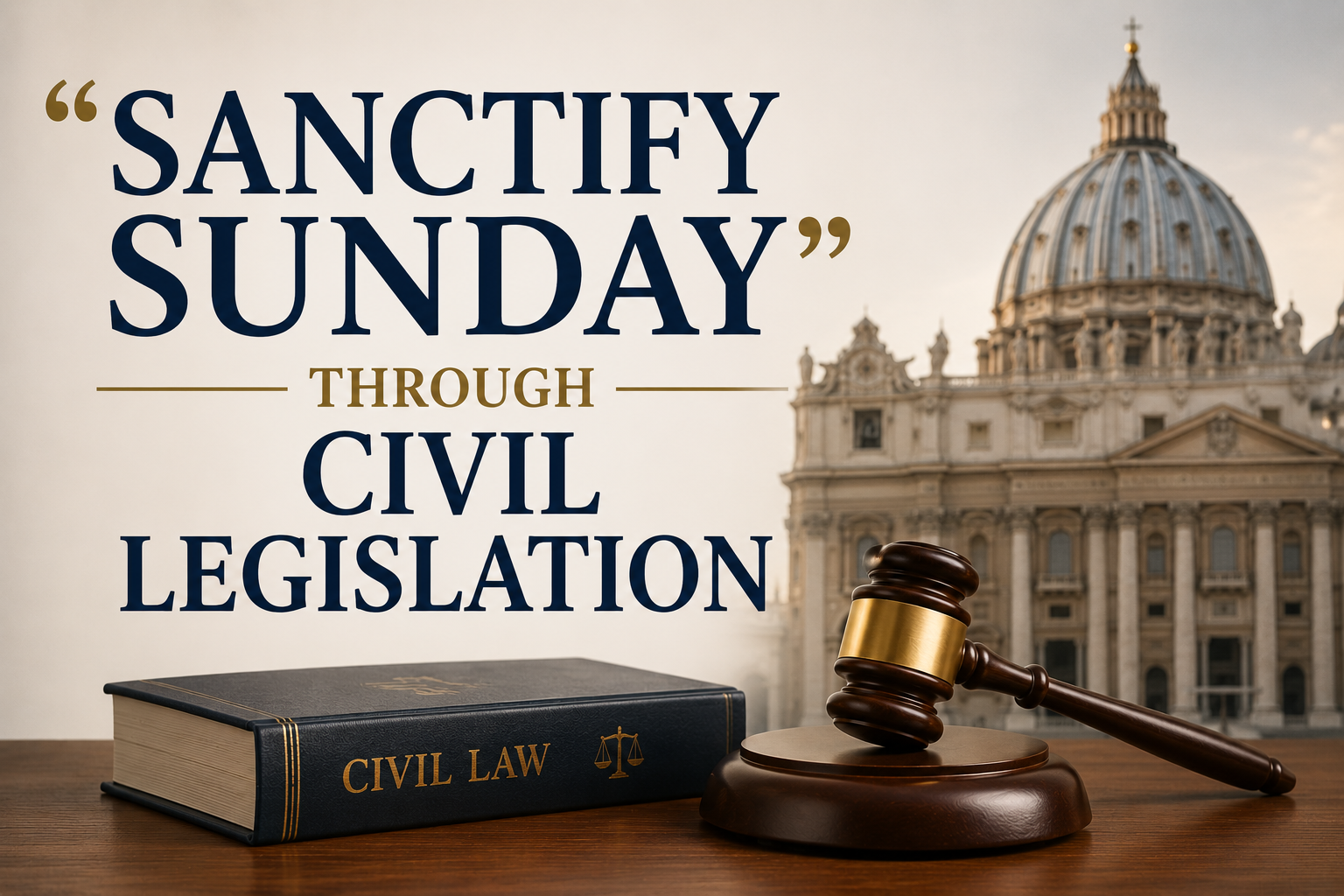
Priestly Life, an online resource for Spanish-speaking Catholic priests, recently published an article by Pedro Maria Reyes Vizcaino, a priest and a doctor of Roman Catholic canon law, titled “The Precept of Hearing Mass on Sunday,” in which he discusses the obligation of Catholics to attend Sunday mass. He also argues that Catholics should advocate for civil legislation enabling governments to protect and “sanctify Sunday.” The Catholic position is one that sees Sunday not only as a church practice but increasingly as a public institution that governments should help preserve for the common good.
Priestly Life expressed the following:
• “For centuries, the Church has prescribed the obligation to hear the entire Mass on Sundays and some more important feasts. The purpose of this article is to explain the scope and legal obligations that derive from this precept, in addition to offering some pastoral considerations.” [1]
• “The faithful are obliged to attend Mass on all Sundays and holy days of obligation, an obligation that entails grave sin if not fulfilled. Paragraph 2181 of the Catechism of the Catholic Church reminds us that ‘the faithful are obliged to participate in the Eucharist on holy days of obligation, unless excused for a serious reason (e.g., sickness, caring for infants) or dispensed by their own pastor (cf. CIC can. 1245). Those who deliberately fail in this obligation commit a grave sin.” [1]
• “The obligation to hear Mass applies to all Catholic faithful from the age of reason who are not legitimately impeded or have not received a dispensation. Therefore, it is binding on Catholic faithful; non-Catholics are not obligated to attend Mass. However, it should be remembered that they have an obligation to worship God, as this is a matter of natural law.” [1]
• “In our time, it must be taken into account that the circumstances of many of the faithful sometimes make it very difficult to fulfill the precept of rest. The current trend is to allow shopping centers to open on Sundays: John Paul II reminds us that “it is natural for Christians to ensure that, even in the special circumstances of our time, civil legislation takes into account their duty to sanctify Sunday. In any case, it is a matter of conscience to organize Sunday rest in such a way that they can participate in the Eucharist, abstaining from work and activities incompatible with the sanctification of the Lord’s Day, with its typical joy, and with the necessary rest of mind and body” Apostolic Letter Dies Domini, no. 67.” [1]
Rome is teaching that Sunday should remain a protected day for worship, rest, and spiritual renewal, even in modern society where economic and commercial pressures make this increasingly difficult. These statements are based on the misguided Catholic belief that Sunday is the “Lord’s Day” and should therefore be regarded as sacred and set apart from ordinary labor and commercial activity.
The Catholic Church acknowledges that many people today work on Sundays and live in economies driven by nonstop commerce. That is why Catholicism teaches that governments should be encouraged to pass laws recognizing Sunday as a special day. According to Catholic social teaching and the common good, they are not advocating for private worship; the objective is to shape society as a whole around Sunday rest.
Statements like these demonstrate Rome’s ongoing efforts to encourage governments and societies to recognize and protect Sunday observance through public policy and civil legislation. This very trajectory—which highlights the growing union of religious influence and civil legislation concerning a day of worship—is part of the developments described in Revelation 13 involving enforced worship and the elevation of human religious tradition above God’s commandments.
Sources
 0
0 0
0 0
0
Sunday worship is the child of the Papacy, according to the inspiration? The Roman Catholic Church is determined to bring the whole world under her dominion, by making political and religious alliances with political and religious leaders with the aim of converging together and merge together under one denominator Sunday worship. The Sunday worship is the common denominator used to identify the WCC member churches who still look to Rome as the moral guidance on the spiritual guidance. Pope Leo XIV, recently wrote an encyclical emphasizing the importance of addressing interests the Artificial intelligence although it did not address the matter concerning Sunday the encyclical (Magnifica Humanitas) the goal still remains the same.
Sunday observance has been emphasized by the last three popes from Pope John Paul II, his Succesor Benedict XVI, and the late Francis I. These pontiffs have been emphasizing the importance of having Sunday as a day of public rest. The Dies Domini and Laudato SI are examples of what will take place in the near future. Sunday observance is a day used by the Roman Catholic Church faithful inorder partake the Eucharist. Eucharist is partaking of BREAD and GRAPEJUICE which are ordinances required to remember the Christ’s sacrifice on the cross. Roman missal is the important religious ceremony in Rome. The partaking of sacrament and the wine.
The whole is being prepared to accept mark of the beast by ignoring the divine precepts and statutes, the Sabbath of fourth commandment is being trampled down. The Man of Sin is exalting himself above every thing that is called God. The world is worshipping satan indirectly by worshipping spurious sabbath and false god of the trinity. The TRINITY -the worship of Father, Mother and Child was the kind of worship which existed through the dark ages for 1,260 days , is now coming to unfold during our lifetime. The IHS worship of Isis , Horus ,Semiramis is the sunday worship, which is partaken as sacrament in the Roman Church. This is what Jesus Christ called it the abomination of desolation in the book of Matthew 24:15. Sunday worship and the trinity doctrine is the common denominator uniting all the apostate churches and they will agree upon all the agreements inorder to enhance the so called unity.
“Through the two great errors, the immortality of the soul and Sunday sacredness, Satan will bring the people under his deceptions. While the former lays the foundation of spiritualism, the latter creates a bond of sympathy with Rome.”—Great Controversy, 588:1.