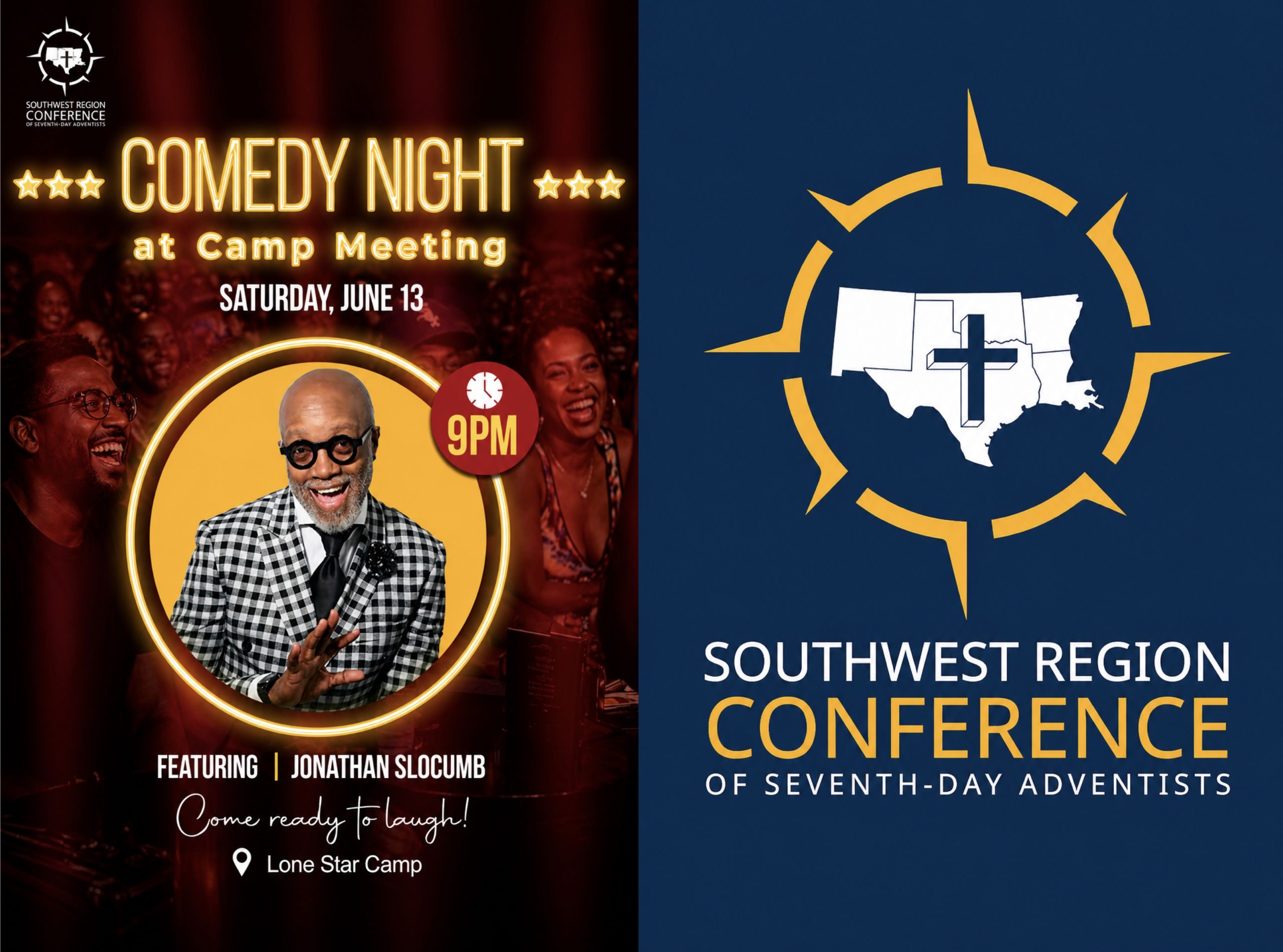
On May 1, 2026, the Southwest Regional Conference of Seventh-day Adventists announced on its Facebook page that its 2026 Camp Meeting would feature an “unforgettable” night of “hilarious comedy.” These events were never part of our camp meetings. These methods reflect the tactics borrowed from Sunday-keeping churches seeking to be culturally relevant. We must be clear: Christ established a church, not a comedy club. Therefore, an entire evening devoted to jokes and laughter cannot be harmonized with the purpose of our major gatherings if we are truly committed to proclaiming the sacred, solemn messages of the Word of God.
The Southwest Regional Conference of Seventh-day Adventists published the following:
• “Comedy night is coming to Camp Meeting! Get ready for a night full of laughter, joy, and unforgettable moments! Saturday, June 13, 9:00 PM, Lone Star Camp, Featuring the one and only Jonathan Slocumb—bringing clean, powerful, and hilarious comedy that will have you laughing all night long! This is more than just a show … it’s a whole experience! Don’t miss it! Grab your friends, your family, and come ready to laugh! [1]
This betrays the very heart of what it means to bear God’s sacred trust in these last days. Our church services and camp meetings are meant to address eternal realities with souls whose destinies hang in the balance. We are called to stand between the living and the dead; to carry such a charge with a spirit of joking and entertainment is to betray the sacred calling of the ministry.
“A spirit of frivolity may be in keeping with the profession of clowns and theatrical actors, but it is altogether beneath the dignity of a man who is chosen to stand between the living and the dead, and to be mouthpiece for God” (Testimonies, Vol. 4, p. 320).
When the holy is mixed with the profane, reverence is lost and sin no longer appears sinful. The pulpit becomes a stage, and our gatherings become platforms for comedy, while the solemn assembly—where the voice of God should be heard—is drowned out by the voice of jokers.
“We are now living in the great day of atonement. In the typical service, while the high priest was making the atonement for Israel, all were required to afflict their souls by repentance of sin and humiliation before the Lord, lest they be cut off from among the people. In like manner, all who would have their names retained in the book of life, should now, in the few remaining days of their probation, afflict their souls before God by sorrow for sin, and true repentance” (Great Controversy, p. 490).
The Day of Atonement was the most solemn day of the year. As recorded in the Book of Leviticus 16 and 23, it was a time when every soul was commanded to “afflict” themselves—through deep heart-searching, repentance, confession, and humility before God. It was not a time for frivolity, lightness, or careless indifference. Eternity hung in the balance; sin was to be confessed and put away so that the people might stand before a holy God.
Those who turn sacred truth into entertainment—and indulge in frivolity while the final work of atonement is proceeding in the Most Holy Place of the heavenly sanctuary—are treating with contempt the very means by which sin is to be put away. This spirit is a fatal condition. This wrong attitude—embraced by many—will only end in perdition:
“And in that day did the Lord God of hosts call to weeping, and to mourning, and to baldness, and to girding with sackcloth: And behold joy and gladness, slaying oxen, and killing sheep, eating flesh, and drinking wine: let us eat and drink; for to morrow we shall die. And it was revealed in mine ears by the Lord of hosts, Surely this iniquity shall not be purged from you till ye die, saith the Lord God of hosts.” Isaiah 22:12-14.
When God calls for weeping, it is no time for laughter. This is the spirit that must be set before the people—an attitude of humility and repentance. This alone prepares the soul for salvation.
“And I will pour upon the house of David, and upon the inhabitants of Jerusalem, the spirit of grace and of supplications: and they shall look upon me whom they have pierced, and they shall mourn for him, as one mourneth for his only son, and shall be in bitterness for him, as one that is in bitterness for his firstborn. In that day shall there be a great mourning in Jerusalem” Zechariah 12:10, 11.
Sources
[1] https://www.facebook.com/share/p/1ArYQdG1y3/
 0
0 0
0 0
0
Christ is our example. Do you imitate the great Exemplar? Christ often wept but never was known to laugh. I do not say it is a sin to laugh on any occasion. But we cannot go astray if we imitate the divine, unerring Pattern. (…) 1LtMs, Ms 11, 1868, par. 6
As we view the world bound in darkness and trammeled by Satan, how can we engage in levity, glee, careless, reckless words, speaking at random, laughing, jesting, and joking? It is in keeping with our faith to be sober, watching unto the end for the grace to be brought unto us at the revelation of Jesus Christ. 1LtMs, Ms 11, 1868, par. 7
The people shoupd fire their SW Union Leaders, come together and pray and re-elect Godly leaders. Altogether too much silence amongst the “lazity”
I spoke with our former pastor over other youth things in the Southwestern Union. It got nothing done. Redirect tithe to the faithful and press on.
These “leaders” are enemies of God and His truth. They do not believe there’s a heaven to gain and a hell to shun. And the people follow along as sheep to the slaughter. And slaughtered they will be if they don’t wake up and flee in a different direction