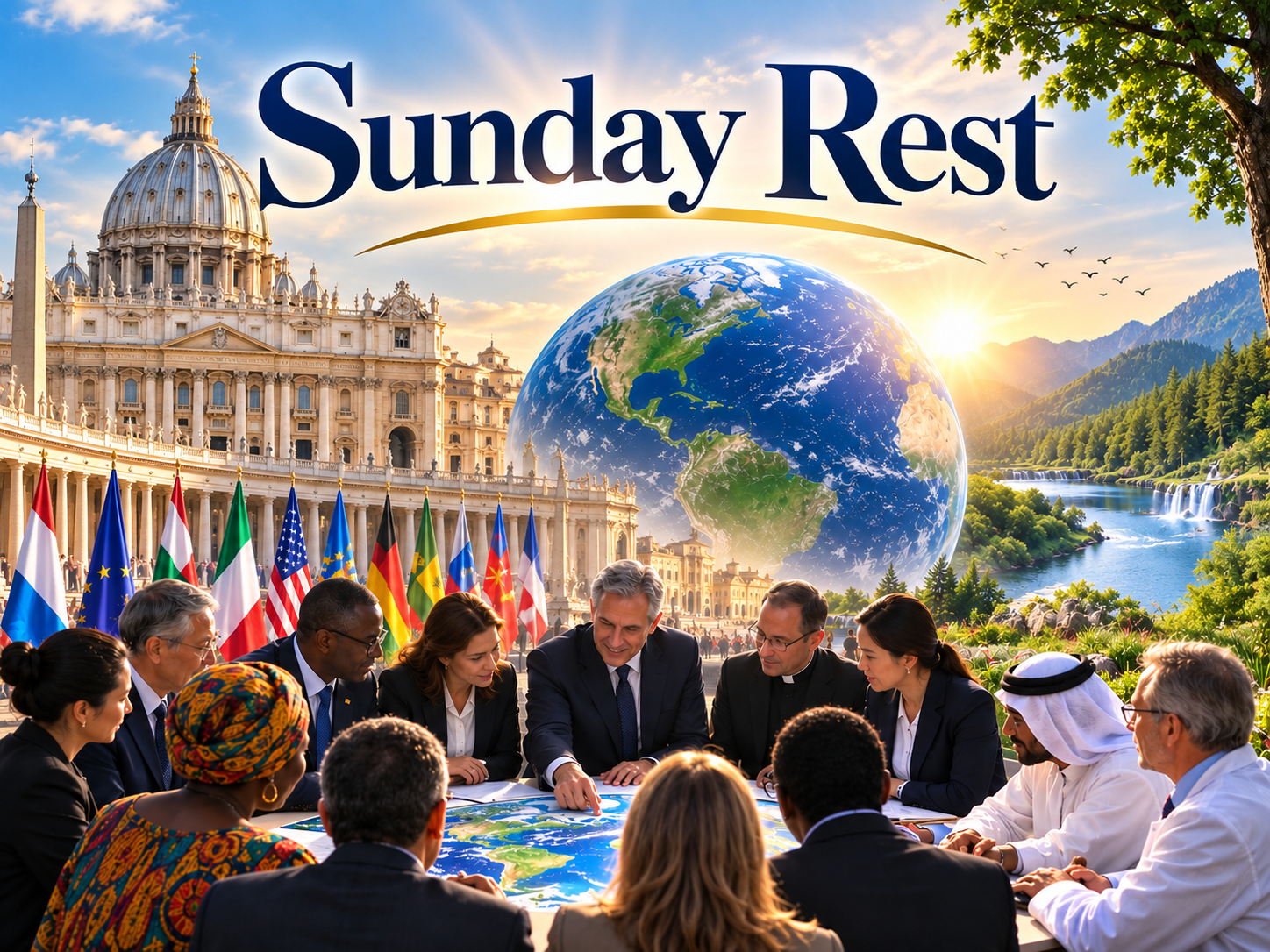
The International Theological Commission (ITC) is an official body of Catholic theologians established to assist the Holy See, particularly the Dicastery for the Doctrine of the Faith, in examining important theological and doctrinal questions. Through a series of consultations held between 2022 and 2025, the Commission prepared a document titled “Caring for Our Common Home.” The final text was submitted to Cardinal Víctor Manuel Fernández, Prefect of the Vatican’s Dicastery for the Doctrine of the Faith, who then presented it to Pope Leo XIV. The document was subsequently approved for publication on August 21, 2026.
The document provides a theological foundation for caring for the earth and seeks to present certain environmental policies as rooted in God’s design for creation. Drawing upon Laudato si’ and other papal teachings and documents, it develops principles for environmental action, envisions governmental implementation of these ideas, and includes a provision for Sunday Sabbath rest.
1 – The Document is for Everyone
“Caring for Our Common Home” was written explicitly from a Catholic perspective, but its intended application extends to all Christians, other religions, governments, civil society, scientists, economists, and ultimately “all men and women of good will” participating in the care of creation, our common home. According to the Vatican Commission, caring for creation can only be accomplished through the cooperation of “all social actors” at both the national and global levels.
• Paragraph #119 – “The principle of responsible care for creation is unfeasible without dialogue and collaboration between all social actors, both at national and global level. This collaboration is the responsibility of international organizations, states, non-governmental organizations, scientists and all men and women of good will. It also concerns us who profess faith in Christ, and this implies dialogue and concerted action by all Christians in an ecumenical key.” [1]
2 – The Document Envisions Governmental Implementation
The “Caring for Our Common Home” document states that the ecological crisis requires the efforts of “law, civil organizations, and governments” and calls for these forces to join together and “actively collaborate” toward making our common home more habitable for everyone.
• Paragraph #133 – “The urgent urgency of the ecological crisis requires that all the forces in the field – science, politics, economy, law, civil organizations, government institutions of public affairs at all levels: state, regional, municipal – join forces and actively collaborate with the aim of making the common home habitable for all.” [1]
The Vatican Commission then discusses the need for stricter ecological policies or laws to be implemented in countries that cause greater harm to the environment than in those that cause less harm.
• Paragraph #125 – “Since we are all inhabitants of the same planet and jointly and severally responsible for its care, it cannot be ignored, however, that environmental deterioration is not caused equally by all human groups or by all countries, nor that it damages everyone to the same extent. Therefore, it is fair that the application of more responsible, demanding and respectful ecological policies is more rigorous for those who damage the common home the most or have so far damaged it the most.” [1]
3 – The Document Has a Sunday Rest Provision
There is a very significant Saturday-to-Sunday transfer when it comes to the Sabbath day in the text of the document. It develops an ecological theology of rest based on the biblical Sabbath and then explicitly transfers the solemnity and meaning of that Sabbath to Sunday.
• “Paragraph #82 – “The Sabbath principle – In the first account of creation we find the root of the sabbatical principle, so widely present in the Torah, with ecological implications. “ [1]
• Paragraph #82 – “Shabbat is a day of rest, according to the example of the Creator God. It also expresses the grateful memory of the liberation from Egypt and the entry into the promised land. [1]
• Paragraph #82 – “In this way, in the Shabbat the faith in the creator and savior God is intertwined, whose honor and reverence are demanded and expressed in the rest of animals, fields and people.” [1]
• Paragraph #83 – “In the Christian tradition, the first day of the week, the dies dominicus, is understood in continuity with the Sabbath, welcoming its meaning and incorporating into it a new Christological and creature dimension, which brings the meaning inscribed in the Sabbath to its full fulfillment.” [1]
• Paragraph #83 – “On Sunday the last day is foreshadowed, in which we hope to enter into God’s rest.” [1]
• Paragraph #83 – “Sunday is for the Fathers of the Church, at the same time, the first day of the week, after Saturday, and the eighth day, the beginning of the new creation.” [1]
• Paragraph #83 – “In the baptism and in the Sunday Eucharist both days, the first and, above all, the eighth, are present.” [1]
• Paragraph #108 – “From the Eucharist is released a spirituality capable of supporting and encouraging the ecological conversion that we so urgently need to undertake as a human family.” [1]
The Vatican Commission establishes Sunday Sabbath rest as an ecological principle. It states that Sunday stands in continuity with the Sabbath and is the new day of rest for Christians. It also associates Sunday Eucharistic worship with creation and presents it as a necessary element for the “human family” to experience an “ecological conversion.” Ultimately, it calls for religion, politics, economics, law, and government at multiple levels to cooperate in caring for the “common home,” while presenting Sunday as a day of ecological conversion and rest.
For Seventh-day Adventists, this should be a wake-up call of the highest order. In many respects, “Caring for Our Common Home” reads like Laudato Si’ on steroids: the ecological coversion philosophy has been further developed, the appeal for cooperation has been extended across religions, politics, economics, law, civil society, and government, and Sunday rest has been tied directly into Rome’s theological vision of caring for creation.
The Vatican is not retreating from the Sunday-rest agenda; it is pushing forward, building a theological, environmental, and political framework in which Sunday is being presented as the new day of worship and as a common good connected with creation, ecological conversion, and rest. By linking Sunday with concerns of the environment, Rome is promoting this day as the universal day of rest for the world.
We were warned long ago that the final controversy will center upon worship, the commandments of God, and the Sabbath. Now is the time to tell the world that the seventh day, or Saturday—not Sunday—is the Sabbath of the Lord, established at Creation, written into the Ten Commandments, and never transferred by divine authority to the first day of the week. The call of Revelation 14:7 must go to the world in a loud voice: “Worship him that made heaven, and earth, and the sea, and the fountains of waters.”
Sources
 0
0 0
0 0
0
The Vatican is leading the world into the Sunday law crisis and everyone, including the Evangelicals are on board.
“While appearing to the children of men as a great physician who can heal all their maladies, he will bring disease and disaster, until populous cities are reduced to ruin and desolation. Even now he is at work. In accidents and calamities by sea and by land, in great conflagrations, in fierce tornadoes and terrific hailstorms, in tempests, floods, cyclones, tidal waves, and earthquakes, in every place and in a thousand forms, Satan is exercising his power. He sweeps away the ripening harvest, and famine and distress follow. He imparts to the air a deadly taint, and thousands perish by the pestilence. These visitations are to become more and more frequent and disastrous. Destruction will be upon both man and beast. “The earth mourneth and fadeth away,” “the haughty people … do languish. The earth also is defiled under the inhabitants thereof; because they have transgressed the laws, changed the ordinance, broken the everlasting covenant.” Isaiah 24:4, 5.
And then the great deceiver will persuade men that those who serve God are causing these evils. The class that have provoked the displeasure of Heaven will charge all their troubles upon those whose obedience to God’s commandments is a perpetual reproof to transgressors. It will be declared that men are offending God by the violation of the Sunday sabbath; that this sin has brought calamities which will not cease until Sunday observance shall be strictly enforced; and that those who present the claims of the fourth commandment, thus destroying reverence for Sunday, are troublers of the people, preventing their restoration to divine favor and temporal prosperity. Thus the accusation urged of old against the servant of God will be repeated and upon grounds equally well established: “And it came to pass, when Ahab saw Elijah, that Ahab said unto him, Art thou he that troubleth Israel? And he answered, I have not troubled Israel; but thou, and thy father’s house, in that ye have forsaken the commandments of the Lord, and thou hast followed Baalim.” 1 Kings 18:17, 18. As the wrath of the people shall be excited by false charges, they will pursue a course toward God’s ambassadors very similar to that which apostate Israel pursued toward Elijah.” GC 589.3 – GC 590.1
Yes, the Sabbath is the Lord’s day. But worship is right if we know what God created. The entire Bible, even as early as the first chapter of Genesis, teaches that the Earth is fixed and covered with a solid, on which the sun, moon, and stars revolve. We do not live on a spinning ball. In many places it says that God is above us. If we were on a ball, God would have to rotate with it to be above us. In other words, the Sabbath was given in honor of Creation. If we believe in a false creation, our worship will be to the one who invented the false creation. So, to sanctify the Sabbath in honor of the spinning ball is worship to Satan.
It is not because of inherent power that year by year the earth produces her bounties and continues her motion round the sun. The hand of God guides the planets and keeps them in position in their orderly march through the heavens. MB 74.3
It can’t be from satan if you can find it in God’s Word!
There’s plenty of evidence in the Scriptures and in nature:
God’s Holy Word tells us that the sun runs on a circuit around earth or that earth revolves around the sun: this how we get time.
Concordance
Circuit – a revolution, that is, (of the sun) course, (of time) lapse: – circuit, come about, end.
Dictionary
Circuit – a course around a periphery
//the periodic circuit of the Earth around the Sun
Sun – It takes 360 days for earth to make a full revolution around the sun.
Moon – It takes 30 days for the moon to make a full revolution around the earth.
Earth – it takes 24 hours for earth to make a full revolution spinning on its axis:
“1 The heavens declare the glory of God; and the firmament sheweth his handywork.
2 Day unto day uttereth speech, and night unto night sheweth knowledge.
3 There is no speech nor language, where their voice is not heard.
4 Their line is gone out through all the earth, and their words to the end of the world. In them hath he set a tabernacle for the sun,
5 Which is as a bridegroom coming out of his chamber, and rejoiceth as a strong man to run a race.
6 His going forth is from the end of the heaven, and his circuit unto the ends of it: and there is nothing hid from the heat thereof.
7 The law of the LORD is perfect, converting the soul: the testimony of the LORD is sure, making wise the simple. ”
Psalms 19:1-7 KJV
Earth spinning/continually on its own axis from north to south:
“5 The sun also ariseth, and the sun goeth down, and hasteth to his place where he arose.
6 The wind goeth toward the south, and turneth about unto the north; it whirleth about continually, and the wind returneth again according to his circuits.
7 All the rivers run into the sea; yet the sea is not full; unto the place from whence the rivers come, thither they return again.
8 All things are full of labour; man cannot utter it: the eye is not satisfied with seeing, nor the ear filled with hearing. ”
Ecclesiastes 1:5-8 KJV
The earth is a circle or a circular sphere:
“21 Have ye not known? have ye not heard? hath it not been told you from the beginning? have ye not understood from the foundations of the earth? 22 It is he that sitteth upon the circle of the earth, and the inhabitants thereof are as grasshoppers; that stretcheth out the heavens as a curtain, and spreadeth them out as a tent to dwell in: ”
Isaiah 40:21-22 KJV
The movement of the sun suggests time:
Joshua 10;27, 1 Samuel 11:9, 2 Chronicles 18:34
Thank you Brother Roman for your diligence and faithfulness in helping God’s people to remain vigilant and informed.
May the Lord continue to bless your efforts regarding matters such as these.
Sister Virginia
You are most welcome!