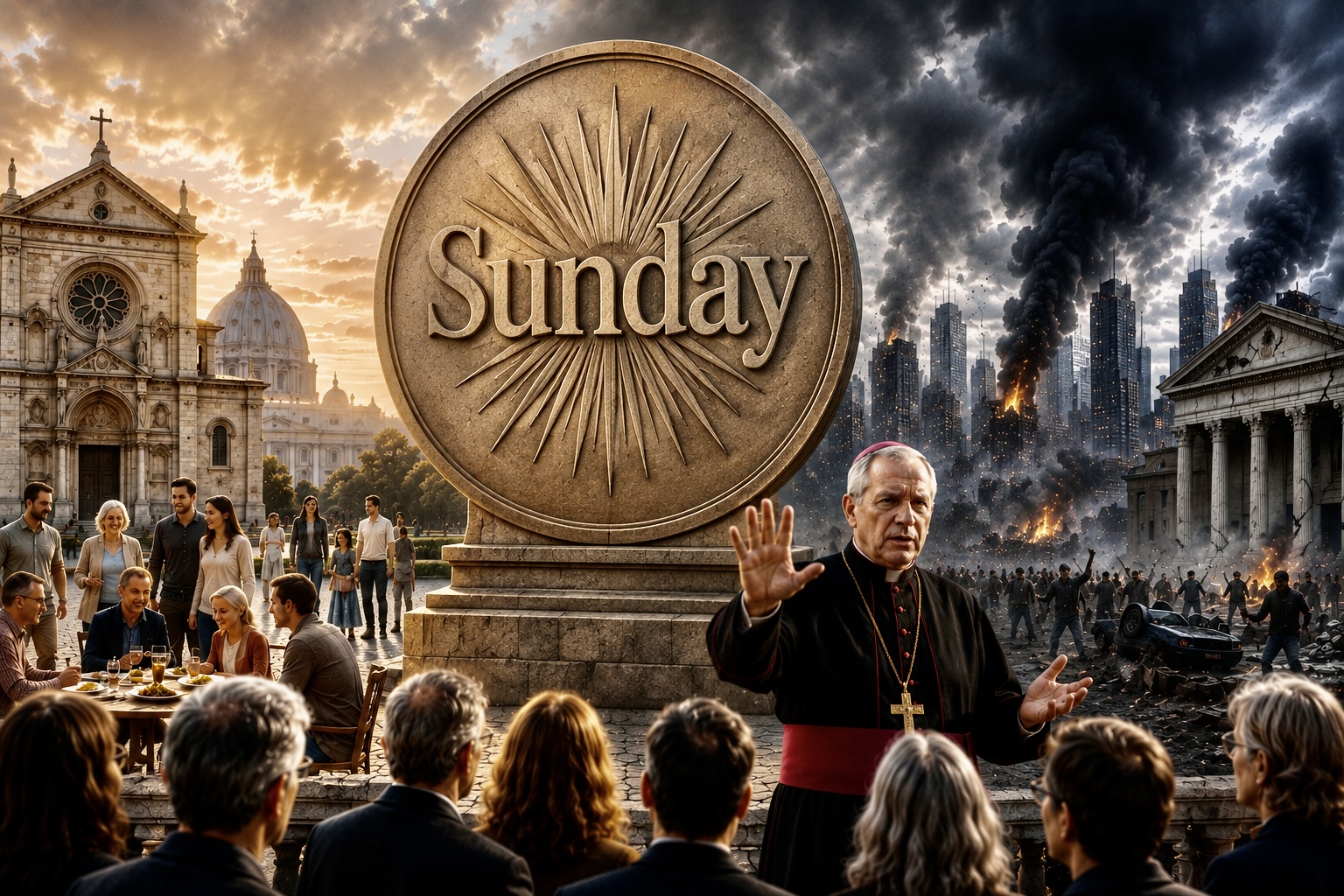
On August 25, 2026, the Roman Catholic Church in Styria, Austria’s second-largest state, published a protest on its official website titled “No Softening of Sunday Rest,” in which it emphatically opposed any relaxation of Sunday-closing laws. The Catholic Church declared that Sunday has served as a common day of rest for “thousands of years” and insisted that it should remain so, warning that any attempt to weaken or change this long-standing practice would threaten society.
The Catholic Church published the following statement:
• “In the course of the current debate about the Sunday opening for small local suppliers, the Catholic Church of Styria is against shopping on Sundays.” [1]
• “A softening of the legal Sunday regulations in this profit-oriented area contradicts the idea of the free Sunday as a common day off for recreation and is clearly to be rejected.” [1]
• “The free Sunday offers common time for family, friends as well as for rest and recreation. Where this is lacking, values that make up our society are threatened.” [1]
• “Sunday is a day that has set the pace for our society for thousands of years and creates space for breaks, for community and celebrations. The Catholic Workers’ Movement of Styria (KAB) is also clearly against further liberalization of shop opening hours.” [1]
Truth is not determined by time. Truth is determined by the Word of God. Sunday may possess centuries of ecclesiastical tradition behind it, but the seventh-day Sabbath possesses something infinitely greater: the direct command of the Creator.
“Remember the sabbath day, to keep it holy…. The seventh day is the sabbath of the LORD thy God.” Exodus 20:8, 10
The question we must ask should be: Will we follow what has been practiced for generations, or will we follow what God has actually said and what He has actually done?
“Thus the heavens and the earth were finished, and all the host of them. And on the seventh day God ended his work which he had made; and he rested on the seventh day from all his work which he had made. And God blessed the seventh day, and sanctified it: because that in it he had rested from all his work which God created and made.” Genesis 2:1-3.
Genesis 2:1–3 is especially significant because the seventh-day Sabbath predates sin, sinners, Israel, Judaism, Catholicism, the Papacy, Protestantism, and even the tradition of Sunday rest. Before there was a Jew or Gentile, before there was a fallen human being, and before there was any religious controversy over days of worship, God Himself established the seventh day at Creation. Scripture says that after completing His work, “God blessed the seventh day, and sanctified it: because that in it he had rested” (Genesis 2:3).
Those actions—God resting, blessing, and sanctifying—occurred in a perfect world. This completely destroys the argument that Sunday should be respected because society has observed it for “thousands of years.” The seventh-day Sabbath is older because it was blessed and sanctified by God at the very beginning of human history.
The Holy Scriptures do not record God removing that blessing from the seventh day and transferring it to the first day of the week. Human beings can establish customs and traditions, and governments can protect Sunday through legislation, but only God can make a day holy. Therefore, Sunday-rest tradition cannot claim authority simply because it is over 1,000 years old. Genesis 2:1–3 takes us beyond church history altogether—back before Constantine, before Rome, before Christianity, before Israel, before Abraham, and even before the entrance of sin. There, at the foundation of the world, we find not Sunday but the seventh day, Saturday, the true Sabbath, and its divine origin.
“The question is, ‘What is truth?’ It is not how many years have I believed that makes it the truth. You must bring your creed to the Bible and let the light of the Bible define your creed and show where it comes short and where the difficulty is. The Bible is to be your standard, the living oracles of Jehovah are to be your guide” (Faith and Works, p. 77).
Sources
 0
0 0
0 0
0
Those who ignore the Lord’s Sabbath to keep holy the first day of the week, offer strange fire to God. It is a strange sabbath, which He has commanded them not. Will He accept it at their hands? Men have sought out many inventions. They have taken a common day, upon which God has placed no sanctity, and have clothed it with sacred prerogatives. They have declared it to be a holy day, but this does not give it a vestige of sanctity. They dishonor God by accepting human institutions and presenting to the world as the Christian Sabbath a day which has no “Thus saith the Lord” for its authority. As did Nadab and Abihu, they offer the common in place of the sacred. ST March 31, 1898, par. 11
How does giving up a man made tradition threaten society?
Giving up a day of worship, a tradition created by man, which have nothing to do with the worship God would be the best thing to do. Why?…
Because when we exalt anything, any idea, any tradition to worship, other than what God has designed as worship, this is IDOLATRY; a breaking of God’s Holy Law!
“3 Thou shalt have no other gods before me.
4 Thou shalt not make unto thee any graven image, or any likeness of any thing that is in heaven above, or that is in the earth beneath, or that is in the water under the earth:
5 Thou shalt not bow down thyself to them, nor serve them: for I the LORD thy God am a jealous God, visiting the iniquity of the fathers upon the children unto the third and fourth generation of them that hate me;
6 And shewing mercy unto thousands of them that love me, and keep my commandments. ”
Exodus 20:3-6 KJV
And Sunday observance (sacredness) is a counterfeit image of God’s Seventh Day Sabbath which was the only day God designated as SACRED.
“1 Thus the heavens and the earth were finished, and all the host of them.
2 And on the seventh day God ended his work which he had made; and he rested on the seventh day from all his work which he had made.
3 And God blessed the seventh day, and sanctified it: because that in it he had rested from all his work which God created and made. ”
Genesis 2:1-3 KJV
Giving it up this man made tradition in OBEDIENCE to God’s Holy and Moral Law
Is the best thing for society.
Christ Jesus tells us:
“15 If ye love me, keep my commandments.
21 He that hath my commandments, and keepeth them, he it is that loveth me: and he that loveth me shall be loved of my Father, and I will love him, and will manifest myself to him. ”
John 14:15, 21 KJV
Look at what the Psalmist said:
“113 I hate vain thoughts: but thy law do I love.
114 Thou art my hiding place and my shield: I hope in thy word.
115 Depart from me, ye evildoers: for I will keep the commandments of my God.
116 Uphold me according unto thy word, that I may live: and let me not be ashamed of my hope.
117 Hold thou me up, and I shall be safe: and I will have respect unto thy statutes continually.
118 Thou hast trodden down all them that err from thy statutes: for their deceit is falsehood.
119 Thou puttest away all the wicked of the earth like dross: therefore I love thy testimonies. ”
Psalms 119:113-119 KJV
And from Proverbs:
“1 My son, forget not my law; but let thine heart keep my commandments:
2 For length of days, and long life, and peace, shall they add to thee.
3 Let not mercy and truth forsake thee: bind them about thy neck; write them upon the table of thine heart:
4 So shalt thou find favour and good understanding in the sight of God and man. ”
Proverbs 3:1-4 KJV
These Promises from God when we keep His Commandments is exactly what society needs!
For disobedience is what brought this world into sin, sorrow, and the ills of society. It is the abandoning of God’s Holy Moral Law is cause of the societal conditions.
“12 Wherefore, as by one man sin entered into the world, and death by sin; and so death passed upon all men, for that all have sinned:
14 Nevertheless death reigned from Adam to Moses, even over them that had not sinned after the similitude of Adam’s transgression, who is the figure of him that was to come.
19 For as by one man’s disobedience many were made sinners, so by the obedience of one shall many be made righteous. ”
Romans 5:12, 14, 19 KJV
And even obedience to Christ Jesus who kept the Seventh Day Sabbath while he was alive:
“27 And he said unto them, The sabbath was made for man, and not man for the sabbath:
28 Therefore the Son of man is Lord also of the sabbath. ”
Mark 2:27-28 KJV
And He rested on the Seventh day in His death, demonstrating the importance of keeping God’s Law and Commandments:
“59 And when Joseph had taken the body, he wrapped it in a clean linen cloth,
60 And laid it in his own new tomb, which he had hewn out in the rock: and he rolled a great stone to the door of the sepulchre, and departed.
61 And there was Mary Magdalene, and the other Mary, sitting over against the sepulchre.
62 Now the next day, that followed the day of the preparation, the chief priests and Pharisees came together unto Pilate, 63 Saying, Sir, we remember that that deceiver said, while he was yet alive, After three days I will rise again.
64 Command therefore that the sepulchre be made sure until the third day, lest his disciples come by night, and steal him away, and say unto the people, He is risen from the dead: so the last error shall be worse than the first. ”
Matthew 27:59-64 KJV
The Seventh Day Sabbath was instituted as part of Creation Week as a Memorial; so that society will not forget God their Creator, and that they are His creation.