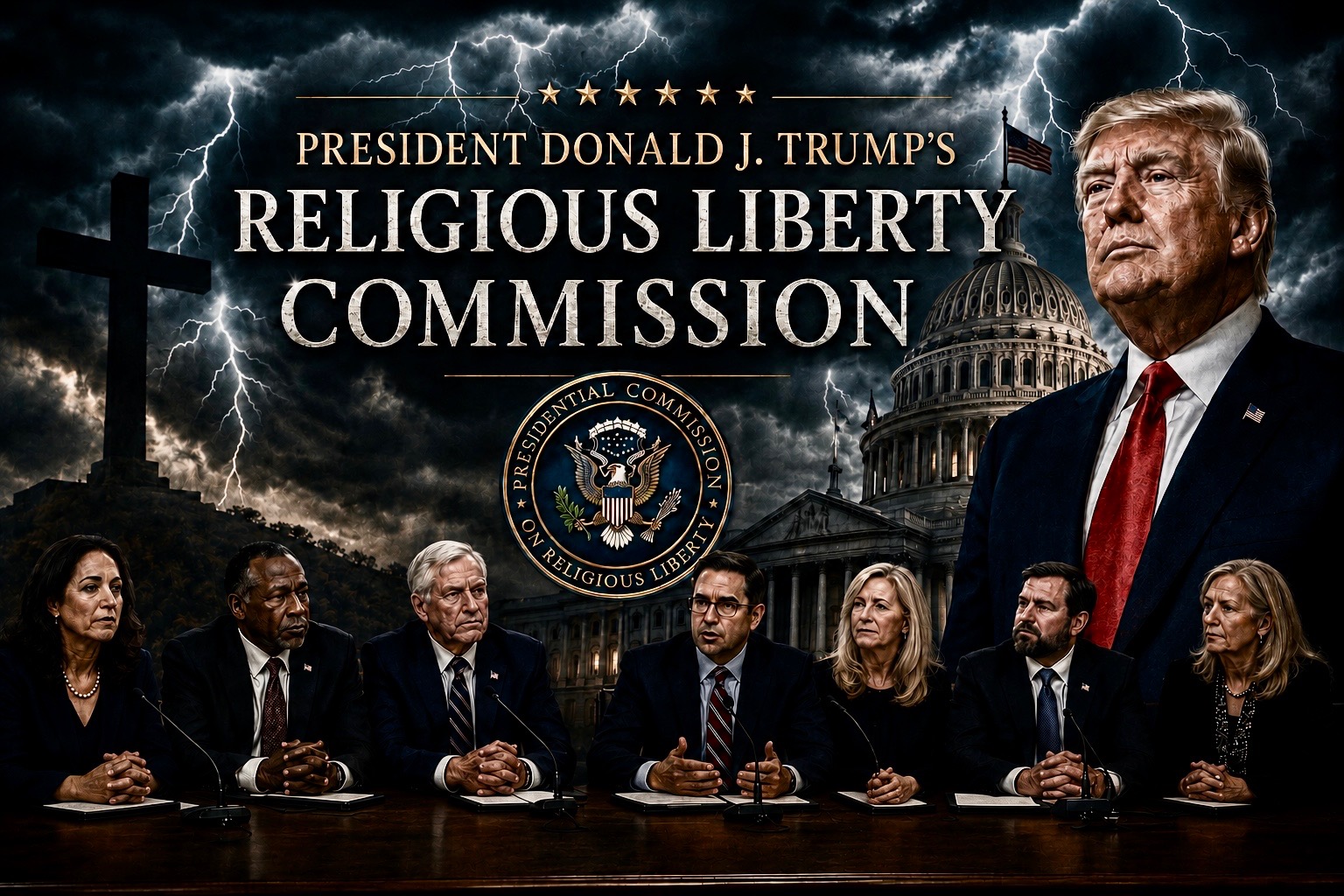
The time to act is now. Submit your concerns to the Presidential Religious Liberty Commission by July 13, 2026, and make your voice heard. Express your objections to the Commission’s draft report, which recommends building “bridges” between church and state and reversing the longstanding constitutional principle that government should remain neutral toward religion—neither promoting nor prohibiting the free exercise of faith in America.
Send your email to the Religious Liberty Commission at RLC@usdoj.gov
************
Below is my letter to the Commission:
To the Members of the White House Religious Liberty Commission,
I respectfully submit this public comment out of deep concern for the future of religious liberty in the United States. I urge the Commission to reject any recommendation directed at the Department of Justice or any other branch of government that would weaken the historic constitutional principle of keeping religion and government institutionally separate, as well as any proposal that encourages greater unity between the two.
America’s greatest contribution to the cause of religious liberty has not been the state’s endorsement of religion, but the protection of every person’s God-given right to worship according to conscience without government interference. This principle has allowed religious communities of every tradition to flourish in freedom while preserving civil peace.
As a Bible-believing seventh-day Sabbath keeper, I write from the perspective of a religious minority whose spiritual ancestors experienced firsthand the dangers that arise when government aligns itself with the religious majority. During America’s colonial period, Baptists, Quakers, Jews, seventh-day Sabbath keepers, and many other religious minorities endured discrimination, imprisonment, fines, and civil persecution because certain established churches enjoyed the support of the state. These injustices were among the very reasons the Founders rejected religious establishments and adopted the First Amendment.
The experience of Seventh-day Adventists provides another historical warning. During the late nineteenth century, Adventists who faithfully observed God’s seventh-day Sabbath were prosecuted under Sunday laws that were imposed, once again, by the religious Christian majority. Some of our fellow believers were fined, imprisoned, and even forced into chain gangs because they chose to honor Saturday as the biblical Sabbath rather than conform to popular Blue Law Sunday observances. Their only offense was obeying the dictates of conscience and remaining faithful to their religious convictions. Their experience stands as a warning that whenever civil authority is used to enforce religious beliefs or practices, freedom of conscience is inevitably endangered, and religious minorities are often the first to endure discrimination and persecution.
The medieval Inquisition demonstrated how religious institutions armed with civil authority suppressed dissent through torture, punishment, and even death. Various forms of religious extremism, including movements that have justified violence in the name of Islam, have shown how state-backed religious ideology can deny liberty of conscience. Likewise, communist regimes that officially embraced atheism illustrate the opposite side of the same error: when government suppresses religion altogether, believers are again persecuted. Though these different oppressive systems differed in ideology, they shared one common characteristic—the concentration of civil power over matters of conscience.
The strength of the American constitutional system is that it avoids these extremes. Government was never commissioned to direct the spiritual lives of the people. The mission of the state is to preserve order, protect individual rights, and secure equal treatment under the law. The mission of the church is altogether different: to preach the gospel, emphasize truth and love through persuasion, not coercion, and call people to a voluntary faith, as Jesus did. These two institutions are strongest and remain uncorrupted when each remains within its proper sphere.
Our nation has become home to a diverse group of churches, synagogues, mosques, and religious communities because government has generally refrained from controlling or establishing religion. This constitutional heritage has protected both the majority and the minority alike. I therefore respectfully urge the Commission to recommend policies that reinforce—not diminish—the constitutional barriers separating ecclesiastical authority from civil government. Religious liberty is best preserved when government neither advances nor inhibits religion but instead protects the equal rights of all people to follow their own conscience.
The United States must remain a nation where every church is free to proclaim its beliefs without governmental control and where every citizen is free to worship—or not to worship—without governmental pressure. History has already taught us the consequences of abandoning this principle. We should not repeat mistakes that countless generations have paid dearly to overcome. For if we do, we would once again be fanning the flames of intolerance, religious bigotry, and injustice.
Respectfully submitted,
Andy Roman from Oklahoma
 0
0 0
0 0
0
This is a superb commentary. Andy Roman is clearly the lead authority on the subject of religious liberty and freedom of conscience out there. He’s the reason why I watch Sunday Law Update regularly. Glory to God.
Thank you for this.
To help anyone out, all I did was put into Gemini “help me draft response against religious liberty draft” and it gave me the exact format to use and the email matched what’s in the site. I just copied and filled out the missing info and removed whatever verbiage I did not want in there.
To the Members of the White House Religious Liberty Commission,
I respectfully submit this public comment out of deep concern for the future of religious liberty in the United States. I urge the Commission to reject any recommendation directed at the Department of Justice or any other branch of government that would weaken the historic constitutional principle of keeping religion and government institutionally separate, as well as any proposal that encourages greater unity between the two.
America’s greatest contribution to the cause of religious liberty has not been the state’s endorsement of religion, but the protection of every person’s God-given right to worship according to conscience without government interference. This principle has allowed religious communities of every tradition to flourish in freedom while preserving civil peace.
As a Bible-believing seventh-day Sabbath keeper, I write from the perspective of a religious minority whose spiritual ancestors experienced firsthand the dangers that arise when government aligns itself with the religious majority. During America’s colonial period, Baptists, Quakers, Jews, seventh-day Sabbath keepers, and many other religious minorities endured discrimination, imprisonment, fines, and civil persecution because certain established churches enjoyed the support of the state. These injustices were among the very reasons the Founders rejected religious establishments and adopted the First Amendment.
The experience of Seventh-day Adventists provides another historical warning. During the late nineteenth century, Adventists who faithfully observed God’s seventh-day Sabbath were prosecuted under Sunday laws that were imposed, once again, by the religious Christian majority. Some of our fellow believers were fined, imprisoned, and even forced into chain gangs because they chose to honor Saturday as the biblical Sabbath rather than conform to popular Blue Law Sunday observances. Their only offense was obeying the dictates of conscience and remaining faithful to their religious convictions. Their experience stands as a warning that whenever civil authority is used to enforce religious beliefs or practices, freedom of conscience is inevitably endangered, and religious minorities are often the first to endure discrimination and persecution.
The medieval Inquisition demonstrated how religious institutions armed with civil authority suppressed dissent through torture, punishment, and even death. Various forms of religious extremism, including movements that have justified violence in the name of Islam, have shown how state-backed religious ideology can deny liberty of conscience. Likewise, communist regimes that officially embraced atheism illustrate the opposite side of the same error: when government suppresses religion altogether, believers are again persecuted. Though these different oppressive systems differed in ideology, they shared one common characteristic—the concentration of civil power over matters of conscience.
The strength of the American constitutional system is that it avoids these extremes. Government was never commissioned to direct the spiritual lives of the people. The mission of the state is to preserve order, protect individual rights, and secure equal treatment under the law. The mission of the church is altogether different: to preach the gospel, emphasize truth and love through persuasion, not coercion, and call people to a voluntary faith, as Jesus did. These two institutions are strongest and remain uncorrupted when each remains within its proper sphere.
Our nation has become home to a diverse group of churches, synagogues, mosques, and religious communities because government has generally refrained from controlling or establishing religion. This constitutional heritage has protected both the majority and the minority alike. I therefore respectfully urge the Commission to recommend policies that reinforce—not diminish—the constitutional barriers separating ecclesiastical authority from civil government. Religious liberty is best preserved when government neither advances nor inhibits religion but instead protects the equal rights of all people to follow their own conscience.
The United States must remain a nation where every church is free to proclaim its beliefs without governmental control and where every citizen is free to worship—or not to worship—without governmental pressure. History has already taught us the consequences of abandoning this principle. We should not repeat mistakes that countless generations have paid dearly to overcome. For if we do, we would once again be fanning the flames of intolerance, religious bigotry, and injustice.
Respectfully submitted,
Thank you, Andy for this beautiful Protestant defense.