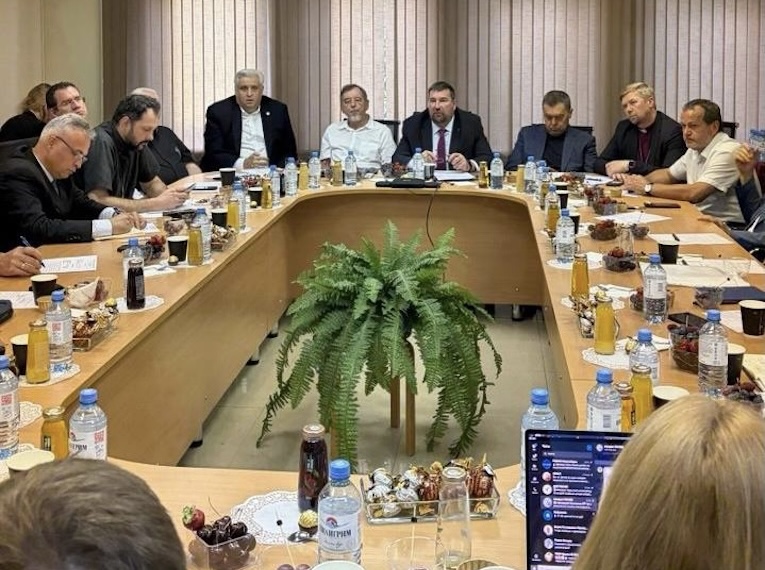
An official Euro-Asia Division report confirms that the Seventh-day Adventist spiritual center in Moscow hosted the 108th meeting of the Advisory Council of Heads of Protestant Churches in Russia. Adventist leader Oleg Goncharov chaired the gathering, which brought together representatives of several major Protestant denominations to plan joint religious, educational, social, and public initiatives. These included interfaith concerts, an ecumenical youth forum involving Protestants, Orthodox Christians, and Roman Catholics, and proposed interfaith sporting events to be held at Zaoksky Adventist University.
On June 11, 2026, the Euro-Asian Division of Seventh-day Adventists published the following:
• “On June 11, the eve of Russia Day, the 108th meeting of the Advisory Council of the Heads of Protestant Churches in Russia was held at the Spiritual Center of the Seventh-day Adventist Church in Moscow. Participants discussed issues of interfaith cooperation, education, the protection of religious freedom, and the preparation of socially significant events.” [1]
• “The meeting was attended by leaders and representatives of the largest Protestant associations in the country, including:” [1]
1 – “Oleg Yuryevich Goncharov, First Deputy Chairman of the Euro-Asian Division of the General Conference of the Seventh-day Adventist Church for Interaction with Government Agencies, Public and Religious Associations, and member of the Presidential Council for Interaction with Religious Associations.” [1]
2 – “Sergei Vasilyevich Ryakhovsky, Head Bishop of the Russian United Union of Christians of Evangelical Faith.” [1]
3 – “Petr Valterovich Mitskevich, Chairman of the Russian Union of Evangelical Christians-Baptists.” [1]
4 – “Sergei Vladimirovich Kartavenko, Deputy Head Bishop of the Russian Union of Christians of Evangelical Faith.” [1]
5 – “Vitaly Vladimirovich Grabovenko, Head Bishop of the Russian Union of Christians of Evangelical Faith.” [1]
6 – “Ivan Sergeevich Laptev, Bishop of the Evangelical Lutheran Church of Ingria in Russia.” [1]
7 – “And other representatives of Protestant churches and organizations.” [1]
• “Another important topic of discussion was the preparation of a youth interfaith forum, which will be held in September 2026. Protestants, Orthodox Christians, and Catholics will participate in its organization and conduct. Participants also discussed holding interfaith sports events at Zaoksky Adventist University.” [1]
• “Summing up the meeting, Oleg Yuryevich Goncharov emphasized that, despite existing theological differences, Protestant churches demonstrate unity in matters of social service, the protection of religious freedom, and public engagement. ‘When we unite for good deeds, it becomes a testimony to the outside world that Christians are ready to serve people together and help those in need, despite existing doctrinal differences. Such cooperation is, first and foremost, a testimony to our Lord Jesus Christ,’ he noted.” [1]
• “The meeting took place in a constructive and businesslike atmosphere, confirming the commitment of Russia’s Protestant churches to further develop interfaith cooperation, strengthen public service, and share witness to traditional Christian values in modern society.” [1]
What makes this development especially significant is that Seventh-day Adventist leaders were not just attending an outside interfaith gathering. The Adventist Division headquarters hosted the meeting, an Adventist leader chaired it, and Adventist representatives helped plan future interfaith activities. Even more, an Adventist university was proposed as the site for interfaith sporting events that would bring Protestants, Roman Catholics, and Orthodox Christians together in a common religious and social witness.
The stated purpose was to demonstrate that churches can cooperate despite their doctrinal differences. Adventist leader Oleg Goncharov declared that when Christians unite in good works, their cooperation becomes a testimony to Jesus Christ. The meeting concluded by affirming a commitment to expand interfaith cooperation, strengthen public service, and develop a shared witness to society.
This is precisely the direction and mission that Pope Leo XIV is promoting. He is calling on the various denominations to form one universal fraternity by downplaying our distinctive doctrines and uniting on the common good. It begins by encouraging churches to participate in joint activities and build what Rome calls fraternity, dialogue, and unity in service.
Under Rome’s model for ecumenism, churches do not have to agree on the Sabbath, Sunday worship, the state of the dead, the sanctuary, the priesthood of all believers, the Eucharist, papal authority, or the nature of salvation. They simply need to agree that these differences should not prevent them from presenting a united Christian witness to society.
For every Seventh-day Adventists, this should be a solemn warning and wake-up call. God did not call this movement into existence to become another member of the wider ecumenical community. Adventists were raised to proclaim the everlasting gospel, the Three Angels’ Messages, the commandments of God, the seventh-day Sabbath, the judgment-hour message, and the call to come out of Babylon. These truths expose serious errors within both Roman Catholicism and apostate Protestantism.
The distinctive doctrines God has entrusted to His people cannot be treated as insignificant denominational differences that should be pushed into the background in order to promote a common social witness. They are the very messages God has commanded us to proclaim to the world. We cannot faithfully warn people about Babylon while helping construct the appearance of universal religious unity that Babylon seeks to achieve.
According to Bible prophecy, the final religious crisis will involve the healing of historic divisions (Revelation 13), the uniting of religious powers (Revelation 17), and their growing influence over society and the state (Revelation 18). The present movement toward common action, shared witness, and interfaith fraternity is creating the atmosphere in which that prophetic union can be achieved.
When biblical truth is set aside so that Rome and the churches can stand together in visible unity, that unity comes at the cost of the distinctive message God has entrusted to His remnant people. Seventh-day Adventists can and must serve the world, but we must do so without obscuring our prophetic identity. Our greatest witness to Jesus Christ is our faithful proclamation of the truths of Revelation 14:6–12 that He has entrusted to us, even when those truths separate us from the world and require us to stand alone.
“The truth and the work of God are unappreciated by a world-loving and compromising Christianity. Not in the ways of ease, of earthly honor or worldly conformity, are the followers of the Master found. They are far in advance, in the paths of toil, and humiliation, and reproach, in the front of the battle ‘against the principalities, against the powers, against the world rulers of this darkness, against the spiritual hosts of wickedness in the heavenly places.’ Ephesians 6:12. And now, as in Christ’s day, they are misunderstood and reproached and oppressed by the priests and Pharisees of their time” (Desire of Ages, p. 508).
Sources
 0
0 0
0 0
0
It is a backsliding church that lessens the distance between itself and the Papacy. ST19, 1894, Art. A, par. 4
Rome never changes. Her principles have not altered in the least. She has not lessened the breach between herself and Protestants; they have done all the advancing. But what does this argue for the Protestantism of this day? It is the rejection of Bible truth which makes men approach to infidelity. It is a backsliding church that lessens the distance between itself and the Papacy. ST19, 1894, Art. A, par. 4
The Lord has pronounced a curse upon those who take from or add to the Scriptures. The great I AM has decided what shall constitute the rule of faith and doctrine, and he has designed that the Bible shall be a household book. The church that holds to the word of God is irreconcilably separated from Rome. Protestants were once thus apart from this great church of apostasy, but they have approached more nearly to her, and are still in the path of reconciliation to the Church of Rome. Rome never changes. Her principles have not altered in the least. She has not lessened the breach between herself and Protestants; they have done all the advancing. But what does this argue for the Protestantism of this day? It is the rejection of Bible truth which makes men approach to infidelity. It is a backsliding church that lessens the distance between itself and the Papacy. ST19, 1894, Art. A, par. 4
“Ye adulterers and adulteresses, know ye not that the friendship of the world is enmity with God? whosoever therefore will be a friend of the world is the enemy of God. ”
James 4:4 KJV
The followers of Christ are to separate themselves from sinners, choosing their society only when there is opportunity to do them good. We cannot be too decided in shunning the company of those who exert an influence to draw us away from God. While we pray, “Lead us not into temptation,” we are to shun temptation, so far as possible. {PP 458.2}
Under Romes model, they all serve the same triune God.
Apostacy is never announced by trumpets, but by subtle infinitismal shift of ephasis till outright heresy, it does proper.
Both the Devil and Catholic apply the law of geometry, that an angle is only small at the point of formation but not at distant periphery.
We are in the downward trajectory to ecumenism and full blown apoastacy.