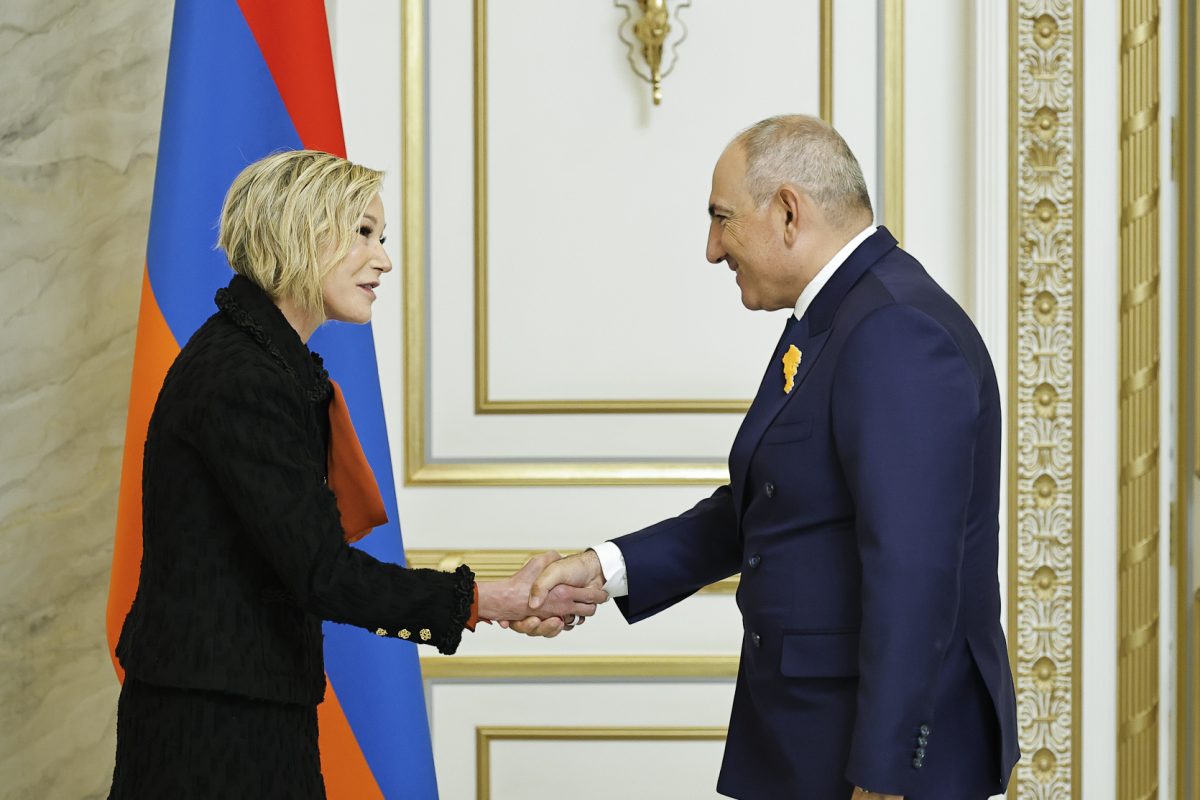
President Donald Trump’s longtime spiritual adviser and Senior Advisor to the White House Faith Office, Paula White-Cain, was in Armenia with Prime Minister Nikol Pashinyan during a national prayer breakfast where remarks explicitly connected Christian faith with the identity and institutions of the state. Prior to the prayer event, White-Cain met personally with Pashinyan, and the Armenian Prime Minister’s Office emphasized the importance of the growing relationship between the two countries, highlighting the United States and Armenia’s “partnership,” “shared Christian heritage,” and “common values.” [1]
Later, during the prayer breakfast attended by political and religious leaders—including Paula White-Cain of the White House Faith Office—Armenian Prime Minister Nikol Pashinyan advanced a vision in which church and state are no longer treated as separate but are instead interconnected and necessary for building what he described as a fair, just, and values-based society.
The Prime Minister expressed the following:
• “Prime Minister Nikol Pashinyan attended the second Prayer Breakfast of the Republic of Armenia. High-ranking officials and statesmen from Armenia and abroad, as well as representatives from diplomatic, business, and spiritual circles, also participated in the event. Paula White-Cain, Senior Advisor to the White House Faith Office, delivered an address.” [2]
• “Prime Minister Pashinyan emphasized that the ideology of ‘Real Armenia’ holds that the Republic of Armenia—within its internationally recognized territory—is the Promised Land, the Promised Land bestowed by God.” [2]
• “It is crucial that the people confront this fact and perceive themselves, their country, and their state as an abode for God. Perhaps this is the foundation upon which we can build a value-based state and a value-based society,’ the Prime Minister noted.” [2]
• “It is very important, however, for that spiritual life to leave the church and enter the streets, homes, the marketplace, local government bodies, the government, and the legislative, executive, and judicial branches. A person is likely to act with much greater integrity if they believe in God. A person will be less vulnerable to corruption risks if they believe in God,” (Prime Minister) Pashinyan said.” [3]
• “He recalled that there was much discussion in Armenia today about fairness and justice, stressing that a judge who believed in God would be fair and that only then would the judge deliver just verdicts.” [3]
• “This is important to me not only spiritually but also in terms of statehood. When we speak about values, we must understand where those values come from. Democracy existed before Christianity, but its modern form derives from Christ. When politicians travel from city to city and village to village, sharing their ideas with people, they are, in essence, emulating the work of Jesus Christ.” [3]
Armenia’s Prime Minister Nikol Pashinyan further indicated that minority religious communities that insist on preserving and publicly emphasizing their distinctive beliefs may not fit within the religious and national vision being advanced for Armenia.
• “Doctrinal disputes among national minorities remain outside this format, which is very important for Armenia. Complete solidarity can exist only around spiritual feelings. We must continue along this path as a path of solidarity, faith, unity and optimism.” [3]
This situation raises a serious religious-liberty concern. Whenever the state begins defining which expressions of faith are considered compatible with the nation’s identity and values, minority believers can quickly find themselves pushed to the margins. What unfolded in Armenia, and in the presence of Trump’s senior spiritual advisor, is particularly concerning because it brings together several elements that Scripture warns will become dangerous when combined: religious influence, political authority, national identity, international cooperation, and an appeal to shared Christian values.
Prime Minister Nikol Pashinyan, speaking in the presence of political, diplomatic, and religious leaders, argued that spiritual life should move beyond the walls of the church and enter the government itself—including the legislative, executive, and judicial branches. He connected belief in God with the proper functioning of government and said that Armenia and its state should be regarded as an “abode for God,” presenting this as a possible foundation for a values-based state and society.
This reasoning is deeply concerning from a religious-liberty perspective. Christianity influencing individual citizens through conscience, free will, and voluntary conviction is one thing; Christian religious principles becoming explicitly merged with national identity and the power of civil government is something entirely different. Prime Minister Pashinyan, in the presence of President Donald Trump’s most senior religious advisor, said that a citizen “should believe in God,” called for spiritual life to enter governmental institutions, and connected faith with the administration of justice and resistance to corruption.
This is exactly how the final union of church and state described in Revelation will begin—a union in which religious minorities will be persecuted for not going along with the popular vision of unity and solidarity. What makes this especially troubling is that these kinds of church-state partnerships are appearing in different parts of the world. It begins with a senior representative of the White House Faith Office and the Prime Minister of Armenia simultaneously emphasizing their partnership, their shared Christian heritage, and their common values.
But it will not end there. It will end when the doctrines of the mainstream churches—specifically Sunday rest—are enforced by law. Revelation 13:11-17 presents political authority enforcing false worship, while Revelation 14:6-12 identifies true worship and obedience to God as the central and final issue in the coming conflict.
Sources
[1] https://en.armradio.am/2026/10/01/pashinyan-welcomes-white-house-faith-adviser-to-armenia/
[3] https://armenpress.am/en/article/1261927
 0
0 0
0 0
0
Leave a Reply