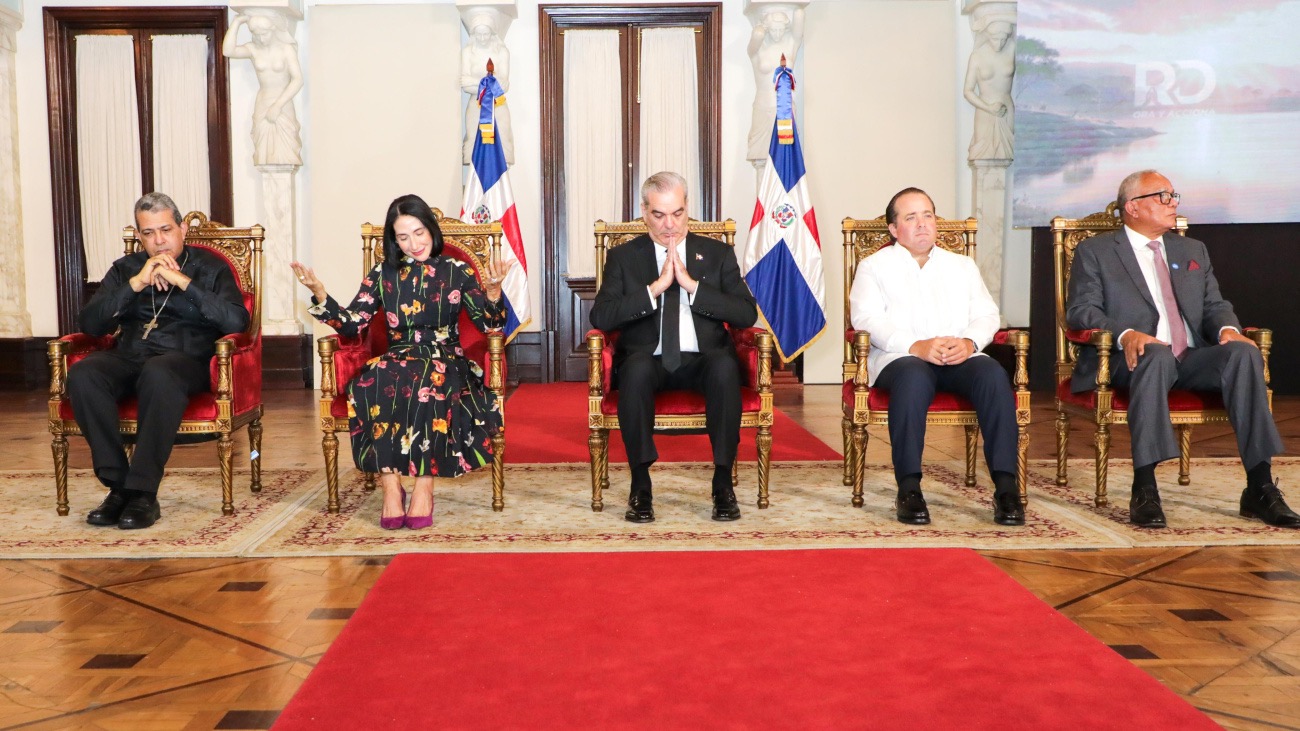
Photo, left to right: Roman Catholic Archbishop Carlos Tomás Morel Diplán; First Lady Raquel Arbaje; President of the Dominican Republic Luis Abinader; Minister of the Presidency José Ignacio Paliza; and President of the Dominican Council of Evangelical Unity, Pastor Fidel Lorenzo Merán.
On September 7, 2026, Dominican Republic President Luis Abinader led Protestants and Catholic leaders and government employees in a National Day of Prayer from the presidential palace, specifically praying for divine protection from natural disasters.In addition, government and church institutions across the country also participated, while officials emphasized the importance of turning faith into action.
The Diario Libre, a Spanish-language newspaper in the Dominican Republic, published an article on September 7, 2026, titled “Abinader Leads Prayer in the Palace so that God Protects Us from Natural Disasters” and united faith and politics for government action. A National Day of Prayer was established, bringing together church and state explicitly as an initiative to seek God’s blessing and protection from natural disasters.
The Diario Libre published the following:
• “President Luis Abinader led this Monday a national day of prayer and thanksgiving for the Dominican Republic, in which he called for uniting faith with concrete actions to face difficulties and prevent the effects of possible natural disasters.” [1]
• “The meeting, held at the National Palace with the first lady, Raquel Arbaje and representatives of different religious denominations and public servants.” [1]
• “During the day, Abinader called for protection for the country from natural disasters and raised prayers for Dominican families.” [1]
• “Pray to find wisdom, to renew hopes, for God to protect us from natural disasters, to pray for a Dominican Republic in peace,’ said the president.” [1]
• “The president maintained that the day must transcend the religious act and become a commitment of service and solidarity.” [1]
• “The activity also had the participation of the coadjutor archbishop of Santo Domingo, Monsignor Carlos Tomás Morel Diplán, who asked for protection, peace and blessings for the Dominican people.” [1]
• “Simultaneously, public servants from different institutions participated in prayer days from their respective headquarters, as part of the initiative.” [1]
By bringing together major religious leaders, the Dominican Republic has implemented a government-backed National Day of Prayer with the aim of seeking divine protection for the nation, including protection from natural disasters. In other words, the Dominican government has brought church and state together in a nationally organized response to the environmental challenges and crises confronting the nation.
This event took place inside the National Palace and was led by the President of the Dominican Republic, who was seated alongside prominent Catholic and Protestant leaders. This was a religious observance taking place at the very center of executive government. Once political leaders become comfortable turning to religious institutions and religious observance as part of the national response to natural disasters, a precedent is established for further church-state cooperation. It shows how government and religious institutions can increasingly work together to promote religious measures.
The transition from “national prayer for protection” to calls for “a national sacred day of rest for creation, family, and social recovery” becomes conceivable when environmental emergencies, natural disasters, religious appeals, and government action begin to converge towards the same goal. This development shows how national emergencies and natural disasters can create opportunities for government to turn to religious leaders for spiritual responses to environmental questions.
One thing is certain: many churches and religious leaders, including voices within the Vatican, are already promoting Sunday rest as part of an ecological response to today’s environmental issues. Inspiration also warns that a time will come when natural disasters and calamities will be connected with the question of Sunday observance. As disasters intensify, religious and political pressure will present Sunday rest as part of the solution to environmental, social, and national crises.
“It will be declared that men are offending God by the violation of the Sunday-sabbath, that this sin has brought calamities which will not cease until Sunday observance shall be strictly enforced” (Great Controversy, p. 590).
Sources
 0
0 0
0 0
0
How can a national day od prayer be taken to mean a push for Sunday rest? Does righteousness still exalt a nation? If so, should that nation not pray?
Praise God that there are national leaders who pray to God!